Papal Palace · October 2026
The 9 popes of Avignon: who were they really?
Avignon can feel wonderfully easy-going today: café terraces, pale stone lanes, busy market mornings and the Rhône moving past the city walls. Then you look up at the Palais des Papes and the scale changes completely. This is not a decorative castle. It is the reminder that, for almost seven decades, one of Europe’s most powerful institutions was run from here.
Between 1309 and 1377, nine popes made Avignon their main residence. They governed the Church, received ambassadors, raised money, settled disputes and shaped international politics from a city that had suddenly become a medieval capital. Their story is bigger, stranger and more human than the neat phrase “the Avignon papacy” suggests.
If you are planning a visit, start with our practical Palais des Papes guide. Then come back to the characters behind the enormous walls: ambitious administrators, reformers, patrons, diplomats and, at times, men caught in a political mess far beyond their control.
Why the papacy left Rome
The move to Avignon was not a casual change of address. Rome in the early 14th century was unstable, marked by rival families, unrest and uncertainty. The papacy had also just emerged from a serious clash between Pope Boniface VIII and King Philip IV of France. When the Frenchman Bertrand de Got was elected pope in 1305 as Clement V, he inherited a job with no obvious safe base.
Clement never settled in Rome. After several years on the move in southern France, he established the papal court in Avignon in 1309. At that point, Avignon was attractive for practical reasons: it sat near major routes, had access to the Rhône and lay close to territories with strong papal links. It was also near France, whose support mattered enormously, without initially being straightforwardly part of the French kingdom.
That distinction matters. The Avignon popes were often criticised for being too close to France, and their opponents later called the period a “Babylonian captivity”. But the papacy was not simply a French office in exile. It remained an international institution, dealing with rulers, bishops, merchants and religious orders from across Europe and beyond.
The city itself changed fast. Clerks, lawyers, bankers, craftsmen, servants, envoys and visitors followed the court. A place with a strategic position became a centre where paperwork, money, art and power all met. You can still sense the physical footprint of that transformation when you walk from the palace towards the old centre and the river.
Clement V and John XXII: making Avignon a papal capital
Clement V, pope from 1305 to 1314, was the first of the Avignon popes. He is often remembered for his relationship with the French crown and for the suppression of the Knights Templar. That episode alone shows how politically exposed his pontificate was: the fate of a powerful military religious order became bound up with royal pressure, Church procedure and European finances.
Clement V did not build the great palace visitors see today, but he set the Avignon experiment in motion. The court was still finding its feet when he died in 1314. A lengthy election followed, reflecting how difficult it could be to choose a pope when cardinals and political interests were divided.
His successor, John XXII, was elected in 1316 and ruled until 1334. John was elderly when chosen, but he was no temporary caretaker. He was a determined administrator who strengthened the machinery of papal government. Under him, Avignon became more clearly organised as a working capital: records, revenues, appointments and legal decisions were handled on a major scale.
John XXII also became involved in arguments over poverty within the Franciscan order and in wider political disputes with the Holy Roman Emperor. These debates can sound distant now, yet they were about real authority: who could define doctrine, who could control wealth and where political obedience should lie.
For a first feel of the city beyond the palace, include the nearby streets, viewpoints and gardens in your plans. Our guide to the Jardin des Doms is a useful companion for slowing down after the intensity of medieval history.
Benedict XII and Clement VI: building the palace and the legend
Benedict XII succeeded John XXII in 1334. A former Cistercian monk, he had a reputation for seriousness and reform. He wanted to bring more discipline to Church administration and religious life, but he also had to accept a hard truth: the papal court needed a secure, permanent base.
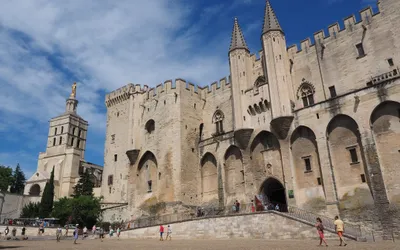
During Benedict XII’s pontificate, the first major phase of the Palais des Papes was built. The older section, often called the Palais Vieux, has the character of a fortress. Thick walls, defensive logic and a disciplined silhouette made sense in a world where safety could not be taken for granted. The palace was a residence, but it was also a statement: the papacy intended to endure in Avignon.
Clement VI, pope from 1342 to 1352, took a different approach. He was more lavish, more openly courtly and more interested in ceremony, art and splendour. Under Clement, the palace expanded with the newer sections and developed into a place suitable for grand audiences and an international court.
Clement VI also made Avignon formally papal territory in 1348 by purchasing the city from Joanna I of Naples. The purchase gave the papacy a firmer legal foundation in the place that had become its home.
His reign was shadowed by the Black Death, which reached Avignon in 1348. The city suffered terribly, like much of Europe. Clement issued protections for Jewish communities who were being falsely blamed and attacked in various places. It was not a solution to the catastrophe, but it was a significant intervention during a period of fear and persecution.
When you walk through the palace, try not to see it only as a tourist landmark. Think of it as Benedict’s fortified answer to insecurity, then Clement’s enlarged stage for a powerful court. The building makes more sense when you hold both ideas together.
Innocent VI, Urban V and Gregory XI: reform, return and reluctance
Innocent VI ruled from 1352 to 1362. He is usually presented as more restrained than Clement VI, and he sought reforms in papal finances and administration. He also faced a Europe still struggling with war, plague and political fragmentation. The Hundred Years’ War, in particular, made the papacy’s diplomatic position more difficult.
Urban V followed, reigning from 1362 to 1370. He is one of the most interesting Avignon popes because he genuinely tried to restore the papacy to Rome. In 1367, he moved there, hoping to re-establish the ancient seat of the Church. The effort did not last. Political conditions and practical pressures led him back to Avignon in 1370, shortly before his death.
That failed return shows that Avignon was not merely a comfort zone. By then, it was where much of the papal system worked. Leaving meant moving people, records, money and diplomatic relationships, while stepping into Rome’s instability.
Gregory XI, elected in 1370, eventually achieved what Urban V could not. He returned the papacy to Rome in 1377. The decision was shaped by politics, pressure from Italian voices and the enduring idea that Rome was the proper seat of Saint Peter’s successor. Catherine of Siena is often associated with encouraging Gregory to make the move, though no single person explains a decision of that scale.
Gregory’s departure ended the Avignon papacy, but it did not end Avignon’s place in the story. The following year, a divided election produced the Western Schism. One line of popes remained in Rome while rival claimants, commonly called antipopes, were based in Avignon. So the city continued to be associated with competing versions of papal authority well into the early 15th century.
The nine popes in one clear timeline
The sequence is worth keeping simple when you visit. Clement V began the Avignon residence in 1309. John XXII made the administration more firmly established. Benedict XII started the formidable palace. Clement VI expanded it and bought Avignon for the papacy. Innocent VI pursued reforms. Urban V made an unsuccessful attempt to return to Rome. Gregory XI finally moved the court back in 1377.
The traditional list also includes Benedict XII, Clement VI, Innocent VI, Urban V and Gregory XI between John XXII and the return. Counting all the men who held the Roman papal office from Clement V through Gregory XI gives nine popes in total: Clement V, John XXII, Benedict XII, Clement VI, Innocent VI, Urban V, Gregory XI, alongside the full succession counted across the Avignon period. The apparent mismatch in short summaries often comes from people compressing the list too quickly, so it is worth checking names against a reliable museum or historical source while you are on site.
More important than memorising every date is understanding the pattern. None of these popes ruled in a quiet era. Each dealt with a Church that was wealthy and widespread but under pressure from kings, wars, religious disputes and public expectations. Avignon gave them security and administrative reach; it also made them vulnerable to accusations that they were distant from Rome and too close to French interests.
Seeing the Avignon popes in the city today
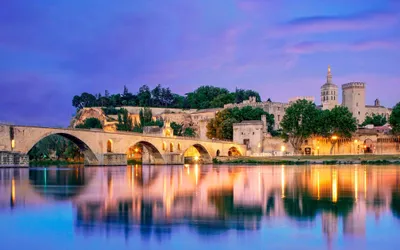
The Palais des Papes is the obvious starting point, but the story spreads beyond one building. Look at the surrounding streets and the city walls, then make time for the Rhône. The medieval papal court depended on movement: people arrived by road and river, news travelled slowly but constantly, and the city’s position made it useful long before modern transport.
Pair the palace with the Pont d’Avignon story for another view of medieval Avignon. The famous bridge is not just a song reference; it helps explain how the river shaped commerce, travel, defence and the city’s connections.
For a relaxed base while exploring the old centre, Lavande Évasion is one of two owner-hosted apartments in Avignon intra-muros, in the Quartier des Teinturiers. Damien and Lubna host Lavande Évasion and Lavande Dorée, making it easy to keep your visit rooted in the city rather than treating Avignon as a quick stop between bigger destinations.
The best way to approach the nine popes is with curiosity rather than judgement. Their Avignon was neither a simple golden age nor a simple scandal. It was a practical response to danger that grew into a grand experiment in governing Europe’s most influential religious institution from Provence.
Stand in front of the palace near the end of the day, when the stone shifts colour and the crowds thin out. It becomes easier to imagine why this place mattered so much. Then give yourself time to wander: Avignon’s papal past is strongest when the huge history of the palace meets the ordinary pleasures of the streets around it.
Frequently asked questions
How many popes lived in Avignon? +
Nine popes resided in Avignon between 1309 and 1377: Clement V, John XXII, Benedict XII, Clement VI, Innocent VI, Urban V, Gregory XI, and two further popes whose pontificates were tied to the Avignon court after Clement V. The usual count of nine refers to the succession from Clement V through Gregory XI.
Why did the popes move to Avignon? +
The papacy left Rome during a period of political instability and conflict in Italy. Avignon offered a safer, better-connected base close to the French kingdom while remaining within the wider orbit of papal authority and diplomacy.
Did Avignon belong to France when the popes lived there? +
No. Avignon was not simply a French city under the French crown. The papacy purchased the city in 1348, and it became papal territory for centuries, although French influence was undeniably strong around it.
Which pope built the Palais des Papes? +
Several popes shaped it. Benedict XII began the older fortified palace in the 1330s, while Clement VI expanded it into the vast ceremonial complex visitors recognise today.
When did the papacy return to Rome? +
Pope Gregory XI returned the papal court to Rome in 1377. His departure ended the Avignon papacy, although the following Western Schism meant that Avignon remained central to a bitter dispute over who was the legitimate pope.
Ready to come?
Stay 5 min from Avignon's historic centre
Two 3-star charm apartments, 2 min from rue des Teinturiers and 18 min from the Palais des Papes. Direct booking, no middlemen.